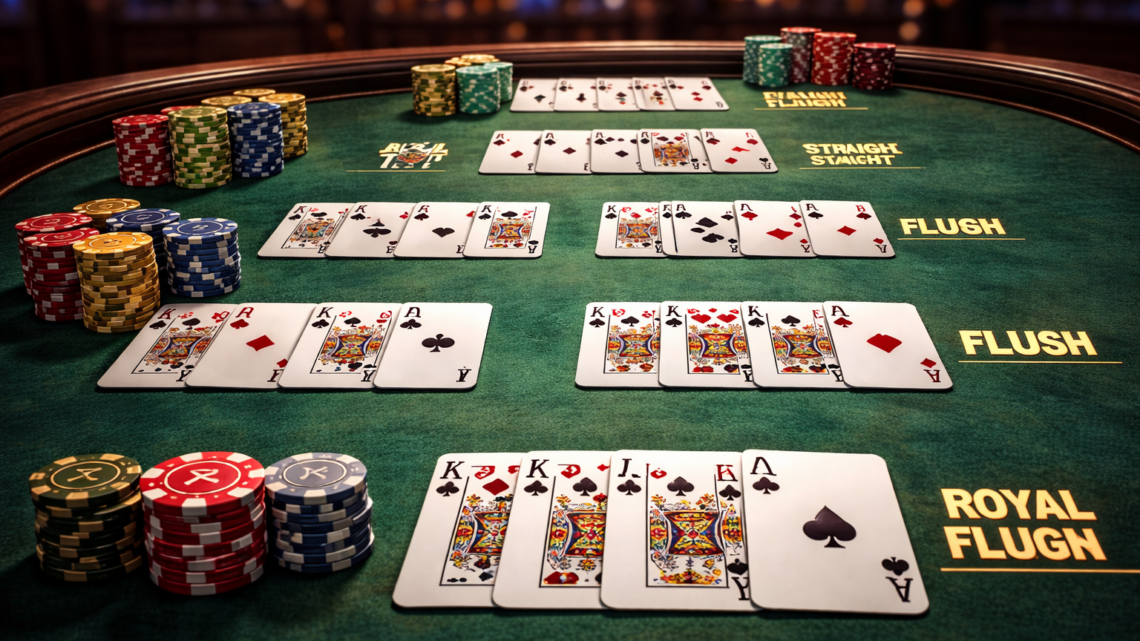
Poker Hands: The Complete Guide to Poker Hand Rankings
Poker hands are the combinations of five cards that determine who wins each round. In poker, hands are ranked from the best possible hand, a royal flush, down to the worst hand, a high card, with nine main categories in between. Understanding these rankings is the foundation of playing poker well.

Learning poker hands might seem complicated at first, but the rankings follow a simple pattern. The rarer a hand is to make, the higher it ranks. Once you know which hands beat which, you can start making better decisions at the table and improving your game.
This guide will show you all the poker hands in order, explain how to compare hands when there’s a tie, and help you understand how hand rankings work across different poker games. You’ll also learn about starting hand strategy, find useful charts to reference, and get answers to common questions about poker hands.
Poker Hand Rankings Overview
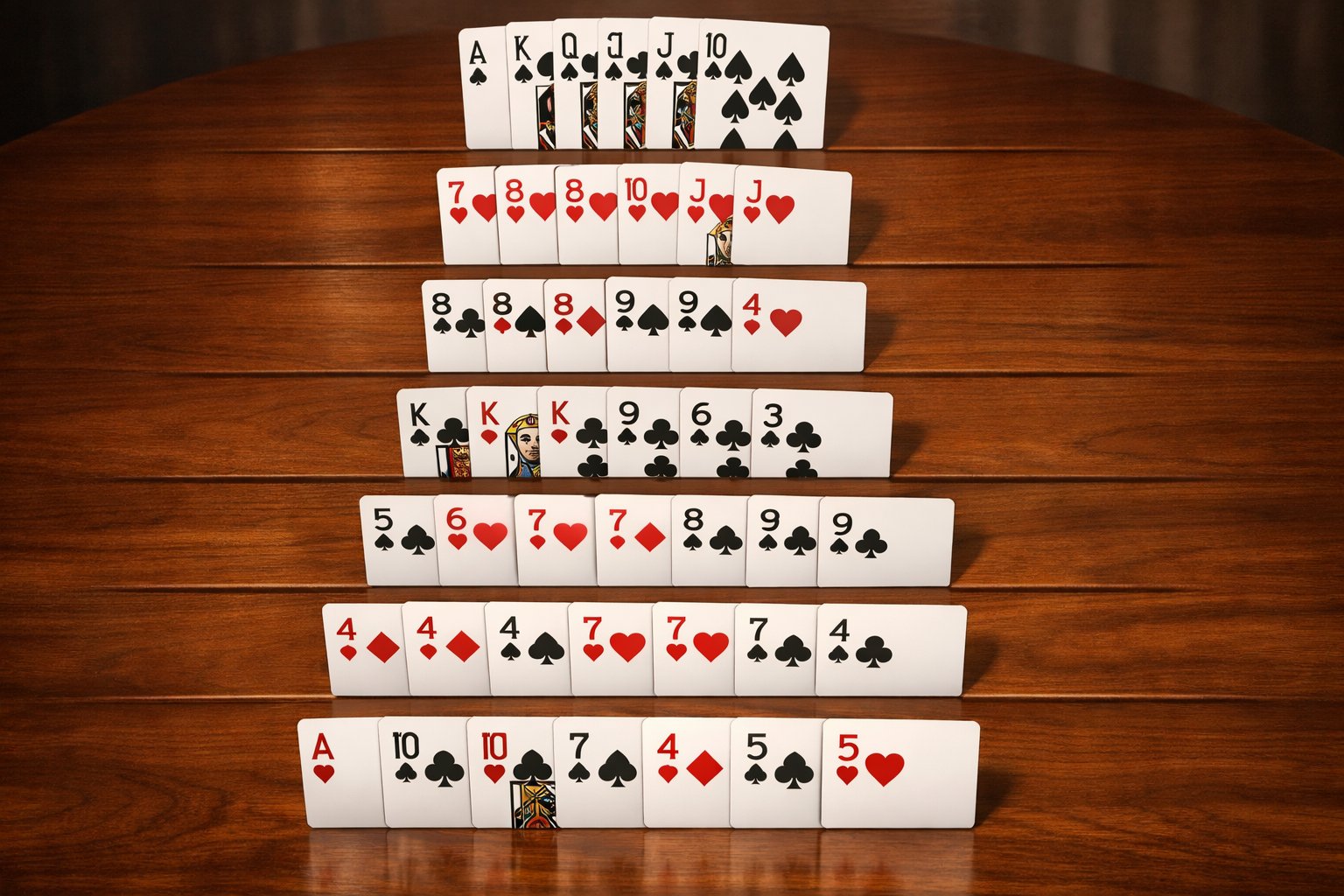
Understanding poker hand rankings is the foundation of playing poker. A Royal Flush beats everything, while a High Card loses to all other hands, and knowing exactly where each hand falls on the poker hand rankings chart determines whether you win or lose the pot.
Official Poker Hands List
The official poker hands list contains 10 distinct hand rankings. At the top sits the Royal Flush, which is A-K-Q-J-10 all in the same suit. The Straight Flush comes next, followed by Four of a Kind, Full House, Flush, Straight, Three of a Kind, Two Pair, One Pair, and High Card at the bottom.
These rankings apply to most poker games, including Texas Hold’em, Omaha, and Seven Card Stud. Each hand beats everything below it and loses to everything above it.
The strongest hands appear less often. A Royal Flush has about a 0.0032% chance of occurring, while One Pair shows up about 43.8% of the time. This rarity makes premium hands more valuable when you get them.
Printable Poker Hand Rankings Chart
A printable poker hand rankings chart shows all 10 hands in order from strongest to weakest. The chart includes an example of each hand so you can see what it looks like. You can download and print these charts to keep at the table while you learn.
Most charts display the hand name, an example with actual card values, and sometimes the odds of making that hand. Some also include the number of possible combinations for each hand type.
Using a chart helps new players avoid costly mistakes. You won’t accidentally fold a winning hand or bet heavily on a losing one. Keep the chart nearby until you have the rankings memorized completely.
What Beats What in Poker
A Straight Flush beats Four of a Kind. Four of a Kind beats a Full House. A Full House beats a Flush. A Flush beats a Straight. A Straight beats Three of a Kind.
Three of a Kind beats Two Pair. Two Pair beats One Pair. One Pair beats a High Card. When two players have the same hand type, the highest cards determine the winner.
For example, a pair of aces beats a pair of kings. A queen-high flush beats a jack-high flush. If the main cards are identical, the kicker card breaks the tie. Suits have no value in determining winners.
Hand Rankings Chart Explained
Reading a hand rankings chart is straightforward. Hands are listed vertically from best to worst. Each row shows one hand type with cards that demonstrate what that hand looks like in practice.
The chart works the same way regardless of which poker game you play. You compare your hand to the chart to see where it ranks, then compare it to your opponent’s hand to determine who wins.
Key elements on the chart:
- Hand name and rank position
- Visual example with specific cards
- Brief description of what makes that hand
- Sometimes probability or odds data
Charts may also include tie-breaker rules. These explain how to determine the winner when two players have the same hand ranking but different cards within that category.
Poker Hands in Order: Best to Worst
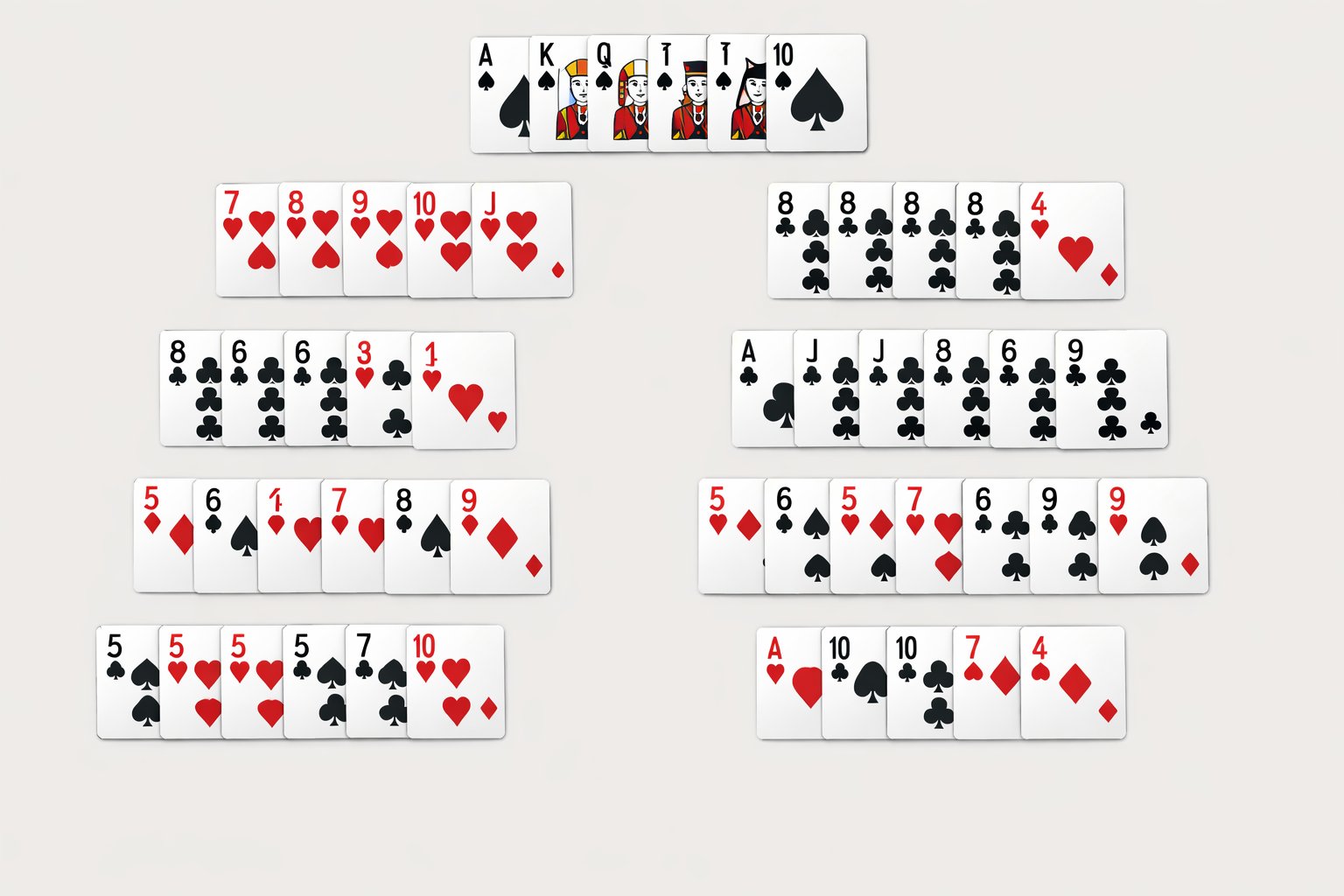
The strongest poker hands follow a specific ranking system that determines winners at the table. A royal flush sits at the top as the best hand in poker, while lower-ranked combinations like four of a kind and full house still pack serious winning power.
Royal Flush Explained
A royal flush is the best hand in poker and cannot be beaten by any other combination. This hand consists of five specific cards: Ace, King, Queen, Jack, and Ten, all in the same suit.
The odds of getting a royal flush are extremely low at 0.000154%, with only four possible combinations in a standard 52-card deck. You can make one royal flush in each suit: hearts, diamonds, clubs, or spades.
If two players both have a royal flush, the pot splits evenly between them since all royal flushes have equal value. The suit does not matter in poker rankings.
This hand is so rare that many players go their entire poker careers without seeing one at the table. When you do make a royal flush, you hold an unbeatable hand that guarantees you at least a share of the pot.
Straight Flush and Royal Straight Flush
A straight flush contains five cards in numerical order, all in the same suit. For example, 9-8-7-6-5 of hearts makes a straight flush. This is the second-best hand in poker, beaten only by a royal flush.
The term “royal straight flush” is another name for a royal flush. Both terms describe the same hand: A-K-Q-J-10 of the same suit.
When two players have a straight flush, the hand with the highest top card wins. A straight flush with a Jack as the highest card beats one with a Ten as the highest card. The probability of getting a straight flush is 0.00139%, with 36 possible combinations in a standard deck.
Straight flushes rank by their highest card, not by suit. If both players somehow have identical straight flushes, the pot splits evenly.
Four of a Kind (Quads)
Four of a kind, also called quads, consists of four cards with the same rank plus one unrelated card. An example would be four Kings with a 6 as the fifth card.
This ranks as the third-strongest hand in poker. The probability of making four of a kind is 0.02%, with 624 possible combinations. When you hold quads, you beat all hands except a royal flush and straight flush.
If two players both have four of a kind, the player with the higher-ranked set of four cards wins. Four Aces beats four Kings. If both players have the same quads (possible when using community cards), the fifth card called the kicker determines the winner. The player with the higher kicker takes the pot.
Full House in Poker
A full house contains three cards of one rank and two cards of another rank. Three Jacks and two Nines make a full house, often stated as “Jacks full of Nines.”
This hand ranks fourth in poker hand rankings. You have a 0.14% chance of making a full house, with 3,744 possible combinations. A full house beats flushes, straights, and all lower-ranked hands.
When comparing full houses, the three-card set (the trips) determines the winner first. Three Aces with two Kings beats three Queens with two Aces. If two players have the same three of a kind, the pair breaks the tie. The higher pair wins.
Full houses represent strong winning poker hands that win most pots. You should play them aggressively since few hands can beat you.
Flushes, Straights, and Middle-Ranked Poker Hands
These middle-tier hands win more pots than you might expect. A flush beats a straight, and both rank above three of a kind and two pair in the hand rankings.
Flush
A flush contains five cards of the same suit in any order. The cards don’t need to be connected or follow a sequence. You could have a heart flush with 2, 5, 9, Jack, and King.
When multiple players have a flush, the highest card determines the winner. If the top cards match, you compare the second-highest card, then the third, fourth, and fifth if needed. An Ace-high flush beats a King-high flush every time.
The suit itself never matters for breaking ties. A heart flush and a spade flush of the same ranks split the pot. This is one of the most common questions new players ask, but suits have equal value in poker.
Straight (Including Ace-High and Wheel)
A straight is five consecutive cards of different suits. You need cards in sequence, like 7-8-9-10-Jack. The suits can be mixed.
The Ace works in two ways for straights. An Ace-high straight (10-Jack-Queen-King-Ace) is the highest possible straight. The wheel or A-2-3-4-5 is the lowest straight, where the Ace plays as a one.
You cannot wrap around with straights. King-Ace-2-3-4 does not count as a straight. The sequence must run in one direction only.
When players both have straights, the one with the highest top card wins. A straight to the Jack beats a straight to the 10.
Three of a Kind and Trips
Three of a kind means you have three cards of the same rank plus two unrelated cards. The other two cards are called kickers. You might hold three 8s with a King and a 5.
The term “trips” refers to three of a kind made with one card in your hand and two on the board in community card games. Set means you have a pocket pair that matches one board card. Both are types of three of a kind.
When comparing three of a kind hands, the highest set of three wins. Three Queens beat three Jacks. If players share the same three of a kind in community card games, the highest kicker breaks the tie, then the second kicker if needed.
Two Pair
Two pair gives you two cards of one rank, two cards of another rank, and one kicker. An example is two 9s, two 5s, and an Ace.
The highest pair determines the winner when multiple players have two pair. If the top pairs match, the second pair decides it. A hand with Kings and 3s beats Queens and Jacks because the Kings are higher.
If both pairs match exactly in community card games, the kicker card breaks the tie. The player with Aces and 8s with a King kicker beats Aces and 8s with a Queen kicker. The total value of adding your pairs together doesn’t matter at all.
Low Poker Hands and Tiebreakers
When you’re dealt weaker hands like one pair or high card, understanding how tiebreakers work becomes critical to knowing when you can win the pot. The strength of your kicker cards and recognizing split pot scenarios can make the difference between walking away with chips or losing them.
One Pair and Pocket Pairs
One pair consists of two cards of the same rank plus three unrelated cards. This hand ranks ninth in standard poker hand rankings, beating only high card.
Pocket pairs are pairs dealt to you in your hole cards, like two 8s or two Kings. These are particularly valuable in Texas Hold’em because they’re already made hands before the flop.
When comparing one pair hands, the rank of your pair determines the winner first. A pair of Jacks beats a pair of 9s every time. If both players have the same pair rank, you compare the highest remaining card (the kicker), then the second highest, and finally the third if needed.
Example: A♠-A♦-K♥-10♣-2♠ beats A♣-A♥-Q♦-10♠-8♣ because the King kicker is higher than the Queen.
High Card
High card is the weakest possible poker hand. You have five unrelated cards that don’t form any combination.
When you don’t make a pair or better, your highest card determines your hand strength. If you hold A♠-J♦-8♣-6♥-3♦, you have “Ace-high.”
Tiebreakers work by comparing cards from highest to lowest. If two players both have Ace-high, compare the second card. If those match, move to the third card, and so on down the line.
This hand wins more often than you might think in bluffing situations or when everyone misses their draws. Sometimes Ace-high is enough to take down a pot when no one connects with the board.
Kicker Importance
Your kicker is any card in your hand that doesn’t directly contribute to your main combination. These cards break ties when players have the same hand type and rank.
Kickers matter most with one pair, two pair, three of a kind, and four of a kind. In a one pair hand, you have three kickers. With two pair, you have one kicker.
Consider this scenario: You hold K♠-9♣ and your opponent has K♦-7♥ on a board of K♣-5♠-2♦-Q♥-4♣. You both have a pair of Kings, but your 9 kicker beats their 7 kicker, giving you the pot.
Always pay attention to your kicker strength, especially with top pair. A weak kicker can cost you chips against players with the same pair but better supporting cards.
Split Pot Scenarios
A split pot occurs when two or more players have identical five-card hands at showdown. The pot gets divided equally among the winning players.
This happens frequently in community card games like Texas Hold’em. If the board shows A♠-A♦-K♣-Q♥-J♠ and you hold 10♣-9♦ while your opponent holds 8♠-7♣, you both play the board (Ace-high straight), resulting in a split.
Split pots also occur when both players have the same pair and their best five cards are identical. If you both hold pocket 3s on a board with A-K-Q-J-2, neither player’s third hole card matters because the board cards are higher.
| Situation | Result |
|---|---|
| Same pair, same three kickers | Split pot |
| Same pair, different kickers | Higher kicker wins |
| Both players play the board | Split pot |
Understanding when a pot will split helps you avoid betting unnecessarily when neither player can win outright.
Poker Hand Rankings in Different Variants
Most poker games use the same hand rankings from high card to royal flush, but the way you form those hands and which hand wins can change based on the variant you play. Some games flip the rankings entirely, making the lowest hand the winner instead of the highest.
Texas Hold’em Hand Rankings
Texas Hold’em uses standard poker hand rankings where a royal flush beats everything and a high card is the weakest hand. You get two hole cards that only you can see, and you combine them with five community cards dealt face-up on the table. Your best five-card combination determines your hand strength.
The community cards come out in three stages: the flop shows three cards, the turn adds one more, and the river reveals the final card. You can use both of your hole cards, one of them, or neither to make your best hand. If you don’t use any hole cards, you’re “playing the board.”
Standard hand rankings in Texas Hold’em from strongest to weakest:
- Royal Flush
- Straight Flush
- Four of a Kind
- Full House
- Flush
- Straight
- Three of a Kind
- Two Pair
- One Pair
- High Card
Seven-Card Stud
Seven-Card Stud follows the same hand rankings as Texas Hold’em, but there are no community cards in this game. You get seven cards total throughout the hand, with three dealt face-down and four face-up. Everyone at the table can see your face-up cards, which affects how betting and strategy work.
You pick your best five cards from the seven you receive to make your final hand. The other two cards don’t count toward your hand strength. This means you have more possible combinations to work with compared to Texas Hold’em, where everyone shares the same community cards.
Omaha Hi-Lo and Community Card Games
Omaha Hi-Lo splits each pot between the highest hand and the lowest qualifying hand. You get four hole cards instead of two, and you must use exactly two of them with exactly three community cards to form your hand. This rule is stricter than Texas Hold’em.
For the low hand to qualify, you need five unpaired cards ranked eight or lower. Aces count as low, so the best possible low hand is A-2-3-4-5, called the “wheel.” Straights and flushes don’t count against your low hand.
You can use different hole cards for your high hand and low hand. For example, you might use two cards for a high straight and two different cards for a qualifying low. If no one makes a qualifying low hand, the high hand wins the entire pot.
Lowball Poker and Razz
Lowball poker flips traditional rankings upside down, making the worst hand in regular poker the best hand in lowball. Razz is the most popular lowball variant, played like Seven-Card Stud but with reversed rankings. Your goal is to make the lowest possible five-card hand from your seven cards.
In Razz, straights and flushes don’t count against you, and aces are always low. The best hand you can make is A-2-3-4-5. Pairs and high cards hurt your hand strength. If you have 7-5-4-3-2, you have a “seven-low” and would beat someone with an “eight-low” like 8-4-3-2-A.
Badugi is another lowball game that uses a completely different ranking system. You want four cards of different suits with different ranks. The best hand is A-2-3-4 with each card a different suit.
Essential Poker Strategy: Starting Hands and Beyond
Strong starting hands give you the best chance to win before community cards appear. Position, hand strength, and opponent behavior all shape how you should play these hands for maximum profit.
Best Starting Hands
The best starting hands in poker include pocket aces, pocket kings, pocket queens, ace-king, and pocket jacks. These hands offer the highest equity against random opponents and should form the core of your playing range.
Pocket aces appear once every 221 hands. When you get them, you have roughly 85% equity against any single opponent preflop. Pocket kings come next with about 82% equity against random hands.
You should raise with premium hands in almost every situation. Playing them aggressively builds the pot when you have an advantage. The only exception is when you’re setting a trap against overly aggressive players, but this requires careful judgment.
Hand Equity Comparison:
| Hand | Nickname | Equity vs Random Hand |
|---|---|---|
| AA | Rockets | ~85% |
| KK | Cowboys | ~82% |
| Ladies | ~80% | |
| AK | Big Slick | ~67% |
| JJ | Hooks | ~77% |
Pocket Aces, Kings, and Queens
Pocket aces demand aggressive play. You should raise or reraise preflop to build the pot and reduce the number of opponents. Slowplaying aces in multiway pots often backfires when opponents catch favorable flops.
Pocket kings require caution when an ace hits the board. If you face strong resistance after an ace appears, folding becomes a reasonable option against tight players. Don’t marry your hand when evidence suggests you’re beaten.
Pocket queens sit in an awkward spot. They dominate most hands but lose to aces and kings. Against tight opponents who four-bet, you should consider folding. Position matters significantly with queens since you need information to navigate difficult boards.
All three hands benefit from position. Playing them from late position gives you more control over pot size and betting action.
Jacks and Other Pairs
Jacks through tens are strong but vulnerable. These hands perform best in position against fewer opponents. You should raise with them but stay flexible when facing reraises from tight players.
Medium pairs like nines and eights work well as speculative hands. They’re profitable when you can see flops cheaply or when opponents fold to your raises. Set mining becomes valuable with these hands in deep-stacked situations.
Small pairs from sevens down to deuces have limited value unless you hit a set. You need the right pot odds to call preflop raises with these hands. Folding them to aggression from early position players is often correct.
Poker Tips for Hand Selection
Your position at the table changes which hands you should play. Early position requires tighter standards since you act first on later streets. Late position allows you to play more hands profitably because you have information advantages.
Position-Based Starting Hands:
- Early Position: Play only premium pairs and AK
- Middle Position: Add jacks, tens, and suited broadway cards
- Late Position: Expand to suited connectors and medium pairs
Table dynamics matter as much as your cards. Tight tables let you steal more pots with marginal hands. Loose tables require stronger holdings to see profit. Adjust your standards based on how your opponents play.
Stack sizes impact hand selection too. Short stacks favor high-card hands like ace-king. Deep stacks give implied odds for speculative hands like small pairs and suited connectors. Match your poker strategy to the game conditions you face.
Poker Hand Charts, Cheat Sheets, and Online Poker Tools
Quick reference materials help you memorize hand rankings, starting hand ranges, and basic odds without slowing down your game. These tools include downloadable PDFs, printable charts, and digital calculators that keep critical information at your fingertips.
Poker Hands Cheat Sheet
A poker hands cheat sheet shows you the complete ranking system from Royal Flush down to High Card in one simple visual. You can reference it during games to confirm which hand beats another and avoid costly mistakes at the table.
Most cheat sheets include additional information like common poker terms, betting actions, and position names. You’ll find definitions for terms like “nuts,” “kicker,” and “pocket pair” alongside the hand rankings. Some versions also show the odds of being dealt specific starting hands, such as the 1 in 221 chance of getting pocket aces.
The best poker hands cheat sheets organize information in clear sections that you can scan quickly. Look for versions that use color coding or visual hierarchy to separate hand rankings from strategy tips and terminology.
Printable Hand Charts
Printable poker hand rankings give you a physical reference you can keep next to your computer or take to live games. You can download these as PDF files and print them on standard paper for immediate use.
Hand charts typically include starting hand recommendations for different table positions. You’ll see which hands to play from early position versus late position, with tighter ranges recommended when you act first. Many charts use a grid format showing all possible two-card combinations with color coding for playable hands.
You can also find specialized charts for different poker variants like Texas Hold’em and Omaha. Each format has different strategic considerations that affect which starting hands are profitable.
Online Poker and Mobile Resources
Online poker tools include odds calculators, equity analyzers, and interactive hand evaluators that run directly in your browser. These digital resources perform instant calculations that would take several minutes to work out manually.
Odds calculators show you the probability of winning with your current hand against various opponent ranges. You input your hole cards and the community cards, and the tool displays your winning percentage. Some calculators also compute pot odds to help you decide whether calling a bet is mathematically correct.
Mobile poker apps often include built-in reference materials you can access between hands. You’ll find hand ranking charts, position guides, and basic strategy tips without leaving the app. Several poker training platforms offer mobile-friendly tools that work on both smartphones and tablets for learning on the go.
Card Values, Suits, and Hand Formation Rules
Every poker hand uses specific card values and suits to determine its strength. In poker, you work with a standard 52-card deck where cards rank from highest to lowest, and you always aim to make the best five-card hand possible from the cards available to you.
Understanding Card Rankings and Suits
The Ace is the highest card in poker, followed by King, Queen, Jack, 10, 9, 8, 7, 6, 5, 4, 3, and 2 (the lowest). The Ace also works as the low card when you need it for a straight (A, 2, 3, 4, 5).
All four suits in poker have equal value. A heart holds the same rank as a spade, diamond, or club. This means a flush made with hearts is worth the same as a flush made with clubs.
The 52 cards break down into four suits with 13 ranks each. No suit beats another suit in poker rules, which keeps the game fair across all poker variants.
How Poker Hands Are Formed
You must create a five-card hand to play poker, even when you have access to more than five cards. In Texas Hold’em, you get two private cards and share five community cards with other players. From these seven total cards, you pick the best five-card combination.
Your final hand can use both private cards, one private card with four community cards, or all five community cards. The goal is to make the strongest possible hand from whatever cards you have available.
Different poker variants give you different numbers of cards to work with. Five-card draw gives you exactly five cards, while Seven-card stud gives you seven cards to choose from.
Rules for Hand Construction
Every poker hand contains exactly five cards when you evaluate it. You cannot have a six-card or four-card hand. If you have more cards available, you must select the best five to represent your hand.
When you form a hand, cards must meet specific requirements for each ranking. A flush needs all five cards in the same suit. A straight requires five cards in sequence. Three of a kind uses three cards of the same rank plus two unrelated cards.
You cannot mix hand types or count cards twice. Each card serves one purpose in your final hand, and you follow strict construction rules based on which hand ranking you are trying to make when you play poker.
Frequently Asked Questions
Poker hand rankings follow a specific order based on how rare each combination is, with a royal flush being the strongest possible hand and a high card being the weakest. Understanding these rankings, their probabilities, and common terminology helps you make better decisions at the table.
What is the hierarchy of poker hands from highest to lowest?
The hierarchy starts with the royal flush at the top, which consists of A-K-Q-J-10 all in the same suit. This is the rarest and most powerful hand you can hold.
The straight flush comes next, featuring five consecutive cards of the same suit. Four of a kind ranks third, containing four cards of the same rank plus one unrelated card.
A full house sits in the middle of the upper tier. It combines three cards of one rank with two cards of another rank.
The flush ranks sixth and includes any five cards of the same suit that aren’t in sequence. A straight follows, made up of five consecutive cards of mixed suits.
Three of a kind contains three cards of the same rank with two unrelated cards. Two pair includes two cards of one rank, two cards of another rank, and one unrelated card.
One pair consists of two cards of the same rank with three unrelated cards. The high card is the weakest hand, where you haven’t formed any combination and your highest card determines your hand’s value.
How is a full house ranked against other poker hands?
A full house ranks as the fourth strongest hand in poker. It beats a flush, straight, three of a kind, two pair, one pair, and high card.
However, a full house loses to four of a kind, straight flush, and royal flush. When two players both have a full house, the one with the higher three of a kind wins.
If both players have the same three of a kind, the higher pair determines the winner. For example, a full house of Queens over 5s beats a full house of Jacks over Aces because the three of a kind takes priority.
What are the odds of being dealt different poker hands?
In Texas Hold’em, when all seven cards are available (your two hole cards plus five community cards), a royal flush appears approximately 0.0032% of the time. This equals roughly 1 in 31,250 hands.
A straight flush occurs about 0.0279% of the time, or 1 in 3,590 hands. Four of a kind happens in approximately 0.168% of hands, which is 1 in 595.
A full house appears about 2.6% of the time, or 1 in 38 hands. A flush occurs in roughly 3.03% of hands, while a straight appears about 4.62% of the time.
Three of a kind shows up in approximately 4.83% of hands. Two pair is more common at 23.5%, and one pair appears about 43.8% of the time.
A high card (no pair or better) occurs in roughly 17.4% of hands. These probabilities assume you see all five community cards, which doesn’t always happen since players often fold before the river.
Can you provide a guide to understanding poker hand rankings in Texas Hold’em?
In Texas Hold’em, you receive two private hole cards that only you can see. Five community cards are then dealt face-up in the center of the table for all players to share.
You form your best five-card hand using any combination of your two hole cards and the five community cards. You can use both hole cards and three community cards, one hole card and four community cards, or even just the five community cards if that makes your strongest hand.
The hand rankings remain the same regardless of which cards you use. Your goal is to create the highest-ranking five-card combination possible from the seven total cards available to you.
Suits have no hierarchy in poker. A flush in spades has the same value as a flush in hearts if the card ranks are identical.
How can you calculate the probabilities of poker hands in various game scenarios?
Your odds change significantly based on which stage of the hand you’re in. Before the flop, you only have two cards, so your chances of making certain hands are different than after seeing the flop, turn, or river.
You can calculate your outs, which are the cards remaining in the deck that will improve your hand. Multiply your outs by 2 to estimate your percentage chance of hitting your hand on the next card.
For example, if you have four cards to a flush after the flop, nine cards of that suit remain in the deck. Your odds are roughly 18% (9 outs × 2) of hitting your flush on the turn.
The more community cards that appear, the more accurately you can assess your final hand’s probability. Position matters because acting later gives you more information about opponents’ actions before you decide.
What are some common poker hand nicknames and their meanings?
Pocket aces (two Aces as hole cards) are called “bullets” or “pocket rockets” because they’re the strongest starting hand. Pocket Kings are known as “cowboys” or “King Kong.”
A pair of Queens goes by “ladies” or “bitches.” Pocket Jacks are called “fishhooks” because of the J’s curved shape.
An Ace and King of the same suit is “Big Slick,” while an Ace-King of different suits is sometimes called “Big Slick unsuited.” Ace-Queen is known as “Big Chick” or “Mrs. Slick.”
Two-seven offsuit is called “the worst hand in poker” because it can’t make a straight easily and has low card values. Three-eight is known as “a ragged hand” because it has little potential.
A full house with three Aces and two eights is called “dead man’s hand,” based on the cards Wild Bill Hickok supposedly held when he was shot. These nicknames vary by region and player community.